Years of sneezing in my own home
Home is supposed to be the place you finally exhale. For about 20 years, since I was 14, mine was the place I braced myself. I'd walk in the door after a long day, drop onto the couch, and within a few minutes my eyes would start itching and the sneezing would kick in. Outside, I felt fine. Inside, on my own couch, I didn't.
The mornings were the worst. I'd wake up stuffy, as if I'd spent the night with my face in a dusty closet. I'd make the bed, shake out the pillows, and set the whole cycle off again. I remember thinking how backwards it was: the room where I was supposed to rest was the room that wore me out.
And then there's the part that made it complicated. I love animals. My dog is family. The dander that set me off was coming from someone I would never give up. Every allergy article I read seemed to land on the same unhelpful advice: just don't have pets. That was never going to be my answer.
dust + dander, the double actSo I started doing what a lot of people do. I bought things.
I wasn't going to choose between my best friend and a good night's sleep. I just needed my home to stop fighting me.
— Jake
I tried everything
If it promised a fresher, cleaner home, I probably tried it. Some of it helped a little. Most of it helped for a while. Here's my honest scorecard, minus the medication side of things. That's a conversation for you and your doctor, not for a guy with a website.
- Room sprays and scented candlesThe room smelled like "linen breeze" for an hour. The dander and dust were still right there underneath, and now I was adding fragrance to the air on top of everything else.masking, not fixing
- A HEPA air purifierHonestly good, and I still own one. The air felt cleaner. But I'd still sit on the couch and start sneezing, because the purifier only cleans the air that actually passes through it.keeper, but only half the job
- Weekend deep cleansVacuum everything, wash everything, wipe everything. Sunday night felt amazing. By Wednesday, it was like I'd never done it.great for three days
- Allergen-proof mattress and pillow encasementsOne of the best things I did for the bed itself. But the bed isn't the only soft surface in a home, and the couch, rugs and pet bed were still loaded.keeper, but it's one surface
- Disinfecting wipes on everythingClean for a moment, then the dust settled right back. It also left the house smelling like a gym locker room.a moment, not a habit
Every fix had the same problem. It either covered something up or reset the clock for a few days. Nothing kept working while I was living my life: sleeping, sitting, letting my dog jump on the bed.
Making it my mission
At some point the frustration turned into curiosity, and the curiosity turned into a bit of an obsession. I stopped buying whatever had the best packaging and started actually reading: how purifiers are rated, what dust mites really are, why dander behaves differently from pollen, what "fragrance-free" means on a label and what it doesn't.
I started testing things for myself, and then for friends. Once people know you're "the allergy guy," the texts start coming in. Which vacuum should I get? Does this purifier work? My partner sneezes every time we visit my parents' place, what do I do? I loved being able to help. It felt like turning years of annoyance into something useful.
this site is basically those texts, organizedThat's really what this site is: the stuff I'd tell a friend over coffee, written down once so I can just send a link. Most of it isn't about any one product. It's about understanding where allergens actually hang out in a home, and then going after them layer by layer. You'll find my whole allergy-home toolkit here, and a 30-day reset checklist you can print.
But there was one thing I learned along the way that changed how I thought about the whole problem.
The thing nobody told me: allergens live on surfaces
For years I thought of my home's air as the whole battlefield. Buy a purifier, clean the air, done. What nobody told me is that the main allergens I react to, dust-mite allergen and pet dander, are relatively heavy particles. They don't hang in the air for long. They settle, usually within minutes, into the softest things in the room: the bed, the couch, the rug, the curtains, the pet bed.
And then they wait. Every time you sit down, roll over, shake a pillow, or your pet jumps off the bed, a little puff of them goes back up into the air you breathe. Then they settle again. Up, down, up, down, all day long.
Once I saw it that way, my whole scorecard made sense. The purifier was cleaning step two. The deep cleans emptied step three, briefly, before it filled right back up. Nothing I owned was working on the surfaces continuously, in the background, while I lived my life.
The line I wish someone had said to me years ago: purifiers clean the air. Allergens and pet odor live on surfaces. You need something for both.
I'd spent years cleaning the air. The problem was living in my couch.
— Jake
Finding probiotics
The first time I read about a probiotic purifier, I laughed. Spraying bacteria around my bedroom on purpose? That sounded like the opposite of what an allergy-prone person should do. I closed the tab.
But it kept coming up while I was digging into the surfaces problem, so I went back and actually read how it works. A probiotic purifier releases a light, fragrance-free mist of beneficial bacteria, natural Bacillus strains of the kind found in soil and plants. The mist settles exactly where allergens settle: on the bed, the couch, the rug, the pet bed. There, the probiotics release natural enzymes that break down allergen proteins like dander and dust-mite allergen, plus the organic matter behind odors. The good bacteria also crowd out the odor-causing ones.
so it works on step 3, the part nothing else touchedThat clicked. But "clicks for me" isn't evidence, so here's what actually convinced me:
Indoor Biotechnologies, 2024 (Cardiff, UK) + EMSL Analytical (New Jersey, USA)
A controlled 8-day application of the EnviroBiotics probiotic, supervised by Dr. Sivasankar Baalasubramanian, with a longer parallel simulation at EMSL. It found a cumulative, statistically meaningful decrease in dust-mite, pet-dander and mold allergens compared with baseline. The probiotic cells release enzymes that break down allergen proteins.
These are environmental results measured on allergens, not medical outcomes. Summary: study summary · EnviroBiotics research page
Invetus (Australia)
Independent veterinary efficacy testing on companion-animal allergens. As a pet person, this mattered to me. invetus.com.au
Probiotic cleaning isn't new
Hospitals in Europe have studied probiotic-based surface cleaning for over a decade as a replacement for chemical cleaning, with stable reductions of unwanted microbes on treated surfaces. See Caselli et al., PLOS ONE 2018, Vandini et al., PLOS ONE 2014 and D'Accolti et al., Microorganisms 2021.
The label stuff I check on everything
EPA-registered formula (EPA Reg. No. 94339-1, use as the label directs). MADE SAFE® certified formula. No ozone, no artificial fragrance, no harsh chemicals. Cartridges are made under an ISO 9001 quality system. It also won a PTPA (Parent Tested Parent Approved) award.
Was I still a little skeptical? Sure. But it was the first thing I'd found that was aimed at the exact part of the problem I'd been ignoring, and it had real lab work behind it rather than just a nice smell.
Living with the BioLogic Mini
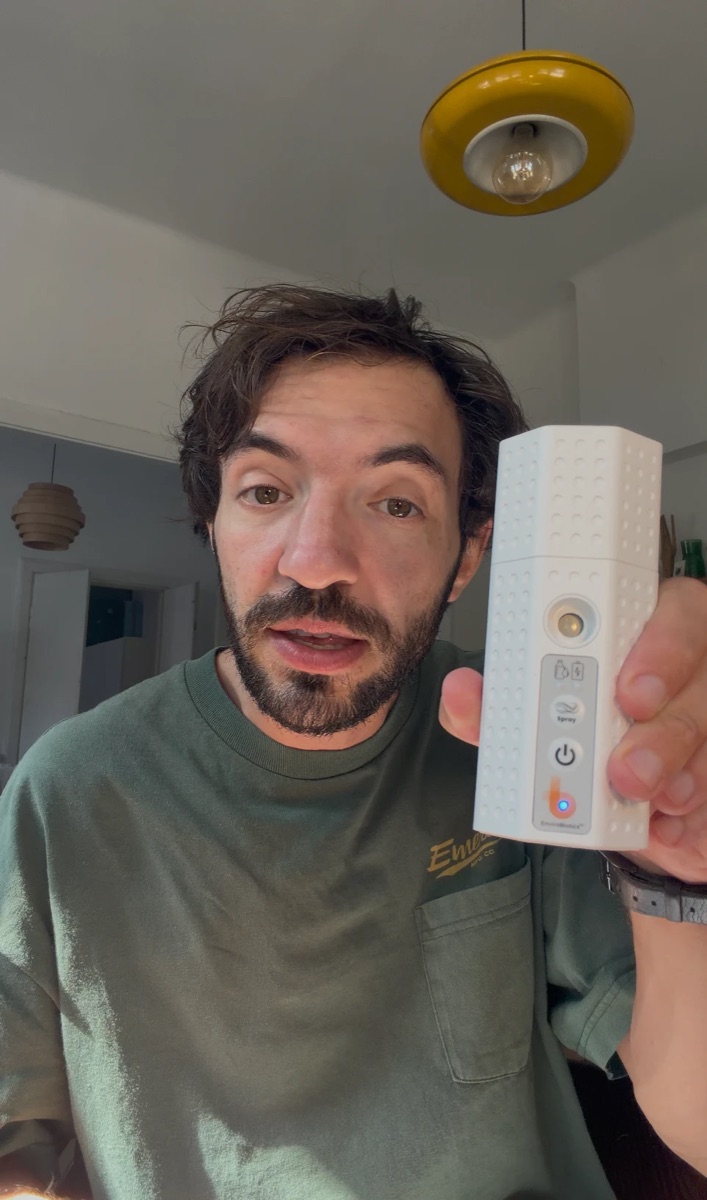
The BioLogic Mini is small, about the size of something you'd keep next to a lamp, and it's cordless. That second part matters more than I expected, because it means you can put it where the problem actually is instead of where the outlet is.

How I use it
Where: mostly in my bedroom. My rule of thumb: put it in the room where you spend the most time, near the softest surfaces. The bedroom first, or right by the pet bed. It covers up to 300 sq ft (with an 8 ft ceiling).
Set and forget: it releases a light mist every few minutes on its own. There's no fragrance, which was a big deal for me after years of candles. It's under 25 dB, so it's nightstand quiet.
Upkeep: up to 4 weeks per charge over USB-C, or just leave it plugged in. One 45 mL cartridge lasts up to about 90 days, and the first one is in the box (along with a USB-C cable and wall-mount brackets). No filters to replace.
Patience: it's not an instant on/off thing like a fan. The lab work showed a measurable drop in allergens on treated surfaces within 8 days*, and most people say they notice a difference in 2–3 weeks. Give it that long before you judge it.
*Lab results on treated surfaces; results depend on the space.


What I noticed
Honestly, it was faster than I expected. I set it up in my bedroom, and two days later I woke up and something was different. After about 20 years of starting every morning the same way, that morning didn't feel like the others. I know two days isn't typical: EnviroBiotics says most people notice a difference in two to three weeks, so give it time.
I'm careful here, because I'm not a doctor and I can't tell you what any product will do for your body. What I can tell you is that it's the first thing in my home that works on the surfaces all the time, not just on cleaning day.
After two days, I woke up feeling different for the first time in 20 years.
— Jake
What other owners say
“We have two cats and a guinea pig. The odors are completely gone.”Amanda I., verified buyer (envirobiotics.com)
“Six months in, I sleep through the night now.”Jay, New Jersey, dog owner (envirobiotics.com)
Rated 4.93/5 from 124 reviews on envirobiotics.com and 4.4/5 on Amazon.
What I'd tell you if you were my friend
If you texted me tonight asking what to do about your dusty, pet-loving, sneezy home, here's what I'd say. First: it's not magic. Nothing is. Anyone who tells you one gadget will fix your home is selling you something (and yes, this site earns a commission on the Mini, which is exactly why I'm telling you this).
A probiotic purifier is one layer. A very useful one, because it handles the surfaces nothing else reaches between cleanings, but it works best as part of a stack:
- Air: a HEPA purifier sized for your room catches what's floating.
- Surfaces: a probiotic purifier like the BioLogic Mini works on the reservoir in your bed, couch and rugs.
- Source: encasements, hot-washed bedding, a sealed HEPA vacuum, washable pet bed covers, and humidity under 50%.
And please, if your allergies are seriously affecting your life, talk to your doctor or an allergist. Making your home friendlier is something you do alongside real medical advice, not instead of it.
Jake's rules for an allergy-friendly home
- Make the bedroom sacred: encasements, weekly hot wash.
- Clean the air and the surfaces. One without the other is half a job.
- Keep humidity under 50%. Dust mites love damp.
- Shoes off at the door. Big mat outside, small mat inside.
- Washable everything: pet bed covers, throws, curtains.
- Vacuum with a sealed HEPA vacuum, not a dust blower.
- No fragrance as a "fix." If it smells, find the source.
- Give any change 2–3 weeks before you judge it.
If you want the whole thing room by room, here's my full allergy-home toolkit. If you like a plan, grab the 30-day allergy-friendly home reset and tick it off as you go. And if you've got questions, I've answered the ones I get most in the FAQ.
Key takeaways
- Dust-mite allergen and pet dander settle into soft surfaces within minutes, then get stirred back up by everyday movement.
- HEPA purifiers clean the air that passes through them; they don't reach the surface reservoir.
- Probiotic purifiers release beneficial bacteria whose enzymes break down allergen proteins on soft surfaces.
- Lab work (Indoor Biotechnologies 2024, EMSL) measured fewer allergens on treated surfaces. These are environmental results, not medical outcomes.
- The best approach is layered: air + surfaces + source habits. Give changes 2–3 weeks.
About Jake and this site
I'm Jake, 34, and I live in Chicago, Illinois. For years I looked for anything that would help with my dust and pet allergies at home, and somewhere along the way it became my mission to find the best products and help other people do the same. That's how I came across EnviroBiotics and probiotic technology.
Disclosure: Jake is a real EnviroBiotics customer. This site may earn a commission when you buy through its links. Jake isn't paid for sharing his story. Amazon links on this site are marked as sponsored. Other tools in the toolkit are generic product types, not paid placements.
Jake isn't a doctor. Nothing here is medical advice. Product facts come from EnviroBiotics' published materials and the research linked above.
Last updated November 2026